
Highlights
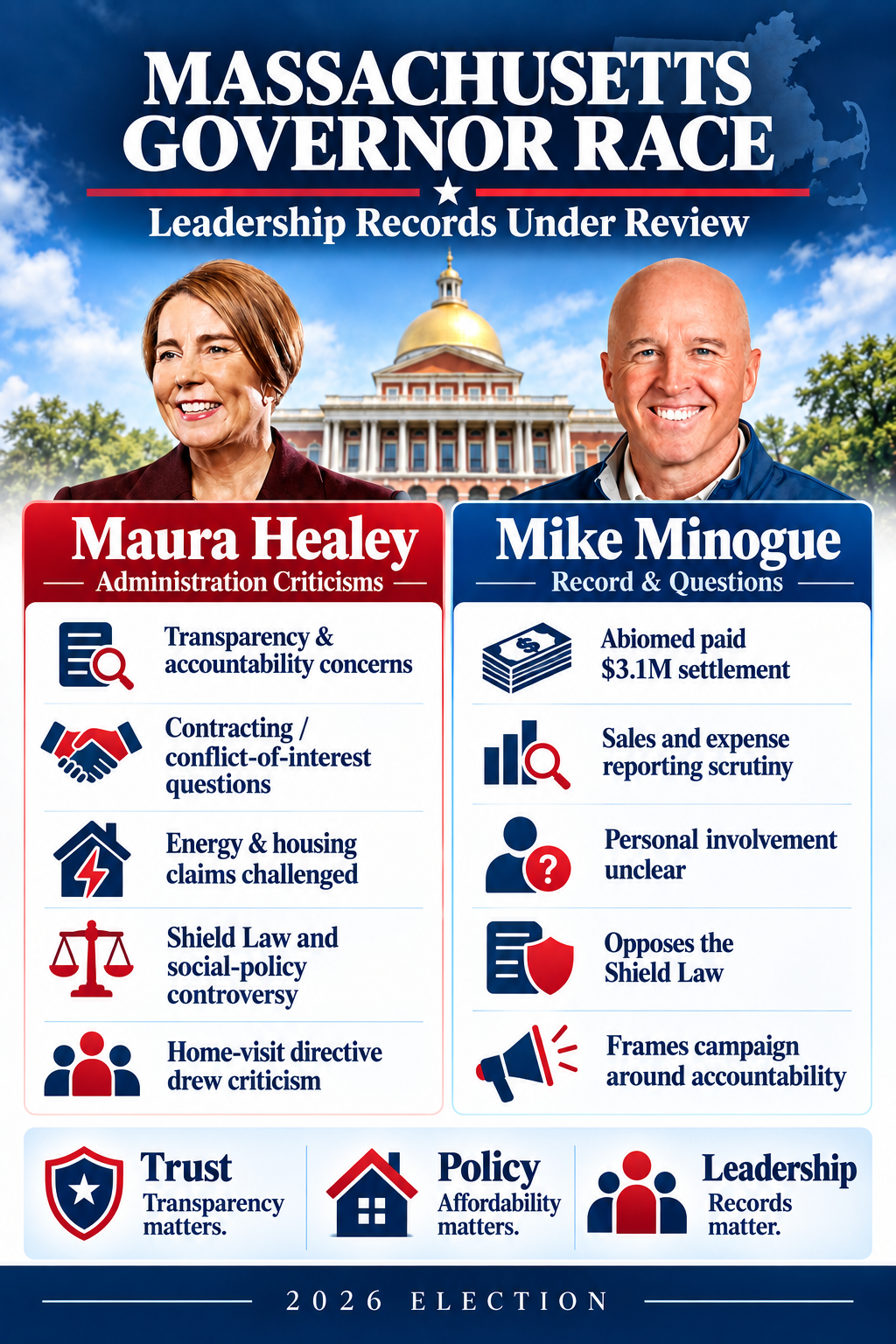
- Governor Maura Healey’s administration in Massachusetts has faced significant criticism for misleading statements, unfulfilled promises, favoritism, the appearance of a conflict of interest and systemic cronyism as well as strict adherence to ideology
- Significant illustrations of conflict of interest are the Applegate Highway Service Plaza and the Springfield Courthouse projects
- She recently signed the Shield Law redefining the abortion laws in Massachusetts
- She recently directed that every household when you have a baby, you’re going to have a home visit… by a healthcare provider to make an assessment
- Her claims of reducing energy prices and policies to increase housing are both not representative of the truth
- ABioMed, where M. Minogue was CEO, faced FDA fines for corporate sales strategies and expense reporting.
- Abiomed paid a $3.1M settlement without admitting wrongdoing
Situation Analysis
Any administrator is faced with decisions on policy and the actions of those under their responsibility. These decisions and actions give insight into the candidates.
Gov. Healey Record
Governor Maura Healey’s administration faces criticism for misleading statements and unfulfilled promises, fostering perceptions of favoritism and cronyism. Issues arise from a reluctance to disclose decision-making criteria, notably in the context of federal findings that identified $338 million in fraud within the Supplemental Nutrition Assistance Program (SNAP). Healey has chosen to boost staffing and budget allocation for the Department of Transitional Assistance rather than share recipient information with the Trump administration.
Complications emerge with state agencies spending over $6.8 million on secret settlements and procurement violations in public-private partnerships, such as the Highway Service Plaza project. The Inspector General cited issues in evaluation methods and potential conflicts of interest regarding the contract awarded to Applegreen, selected primarily because they projected more heavy EV usage and overstated estimated retail sales. The Springfield Regional Justice Center project, involving a $2 billion cost over 40 years violated the RFP by not transferring ownership to the state after the 40 year period, also has ties to political figures raising conflict of interest alarms.
Inadequate accountability continues, with public demands for audits following MassDOT’s investigations uncovered excessive billing in overtime hours among state highway maintenance workers, leading to public demands for audits[1]. The shelter system faces scrutiny amid a migrant influx resulting from emergency state contracting practices involving costly no-bid contracts awarded to organizations linked to Healey’s campaign, such as the Valley Opportunity Council’s $950,000 contract to Key Food Marketplace, whose owner serves on its board and high prices for services, such as $150 cab rides. Further allegations of preferential treatment have arisen concerning catering contracts awarded to donors of the governor’s campaign. Public records claims and fiscal health criticisms, particularly regarding the Massachusetts Bay Transportation Authority’s projected $560 million deficit, further intensify discontent.
The administration has failed to publicly release an important 2024 economic analysis related to costs associated with Net Zero Policies[2]. The controversial hire of LaMar Cook (arrested for drug trafficking), an individual with no prior relevant experience and a criminal history, as deputy director raises eyebrows about Healey’s hiring practices favoring political allies over qualified candidates.
On policy fronts, Healey signed legislation enabling unrestricted abortion access and supported gender-affirming care for transgender youth. She directed Social Services “Everybody in the state, when you have a baby, you’re going to have a home visit. You’re going to have a home visit within days, weeks, and that will be an opportunity for a healthcare provider to make an assessment and to see if you need some additional support and resources.” The administration has pursued punitive measures against towns opposing her MBTA mandates while they criticize the threats from the Federal government against sanctuary cities. Her climate policies have led to increased waste disposal costs, due to landfill and incinerator closures, forcing towns to transition to state subsidized 30-gal trash containers like those adopted in Westford. Healey’s claims of progress in energy costs and housing have been challenged; electric and gas bill reductions are seen as temporary loans rather than real cuts, and housing completions are largely attributed to the previous administration. Her plans to provide $25 million to help people buy homes and the plan to give $25,000 checks to first-time home buyers will lead to increased competition for a limited number of homes, driving up prices and destabilizing the market rather than addressing the root issue of the housing shortage
Healey’s appointments to the Supreme Judicial Court raise concerns about transparency, contrasting with past governors’ practices. Additionally, she is advocating to delay state level tax cuts associated with Trump’s administration’s ‘Big Beautiful Bill’.
Back when she was attorney general, Governor Maura Healey’s office tried to stop parents from using a lawsuit to get records about child sexual abuse at Bridgewater State University’s day care center.
A judge blocked her office’s effort in 2016 and accused state officials of protecting themselves as families sought answers.
The fight came after law enforcement arrested Kyle Loughlin in March 2015. The BSU student worked at the campus Children’s Center. Authorities charged him with sexually assaulting a 4- and a 5-year-old boy.
Parents of four children wanted records showing what happened. They also wanted to know if university officials ignored warnings or covered up abuse.
Their lawyer, Carmen Durso, sought evidence for a possible federal civil rights lawsuit. Healey’s office defended university officials and asked the court to dismiss the case.
Suffolk Superior Court Judge Dennis J. Curran refused.
“Who speaks for the children in this case,” Curran wrote in his January 29, 2016, ruling.
“Not the Attorney General’s office, charged with protecting the public safety, not a few university administrators who seem to have forgotten the original purpose of an educational institution: to seek the Truth,” he added. “Instead, we see only petty bureaucrats scurrying to protect themselves.”
Curran said the parents had already made two public records requests, but didn’t get the answers they wanted. He said the state used a legal technicality to fight their case.
“These are simple requests, and yet the Commonwealth, knowing full well that those two requests to date have been fruitless and an utter waste of time, engages in gamesmanship in continuing to deny these parents the relief to which they are entitled,” he wrote.
Healey’s office said it worked with the parents and told the university to release some records.
In April 2017, Healey defended her office’s actions once again.
She told The Enterprise that the parents should’ve used the public records process instead of a separate court case to get evidence. She also cited privacy laws.
“There was a good reason why we took the actions that we did,” Healey said.
“But I’m somebody who’s always going to push for transparency,” she added.
The parents’ lawyers said they had already tried that process unsuccessfully.
Healey’s office didn’t appeal Curran’s ruling.
Loughlin pleaded guilty in March 2017 to two counts of rape and abuse of a child, three counts of indecent assault and battery on a child under 14 and one count of larceny from a building. A judge sentenced him to seven-and-a-half years in prison and 10 years of probation.
In 2017, day care director Judith Ritacco admitted she failed to report abuse and intimidated a colleague who wanted to report it. She received a three-year probation sentence without a guilty finding.
Four years later, a judge found Loughlin to be a Sexually Dangerous Person and ordered him committed to the Massachusetts Treatment Center.
Mike Minogue Record
Minogue is a devout Catholic and opposes the Shield Law. He has stated that he will support the law, but disagrees with its tenants.
[1] Mass Fiscal Alliance; $2 Billion Contract, Major Political Connections, and No Ethics Concerns? July 2026
[2] Mass Fiscal Alliance and Mike Urban Massachusetts WILL NOT Be Happy With What I Found; Aug 20, 2026
Leave a Reply