
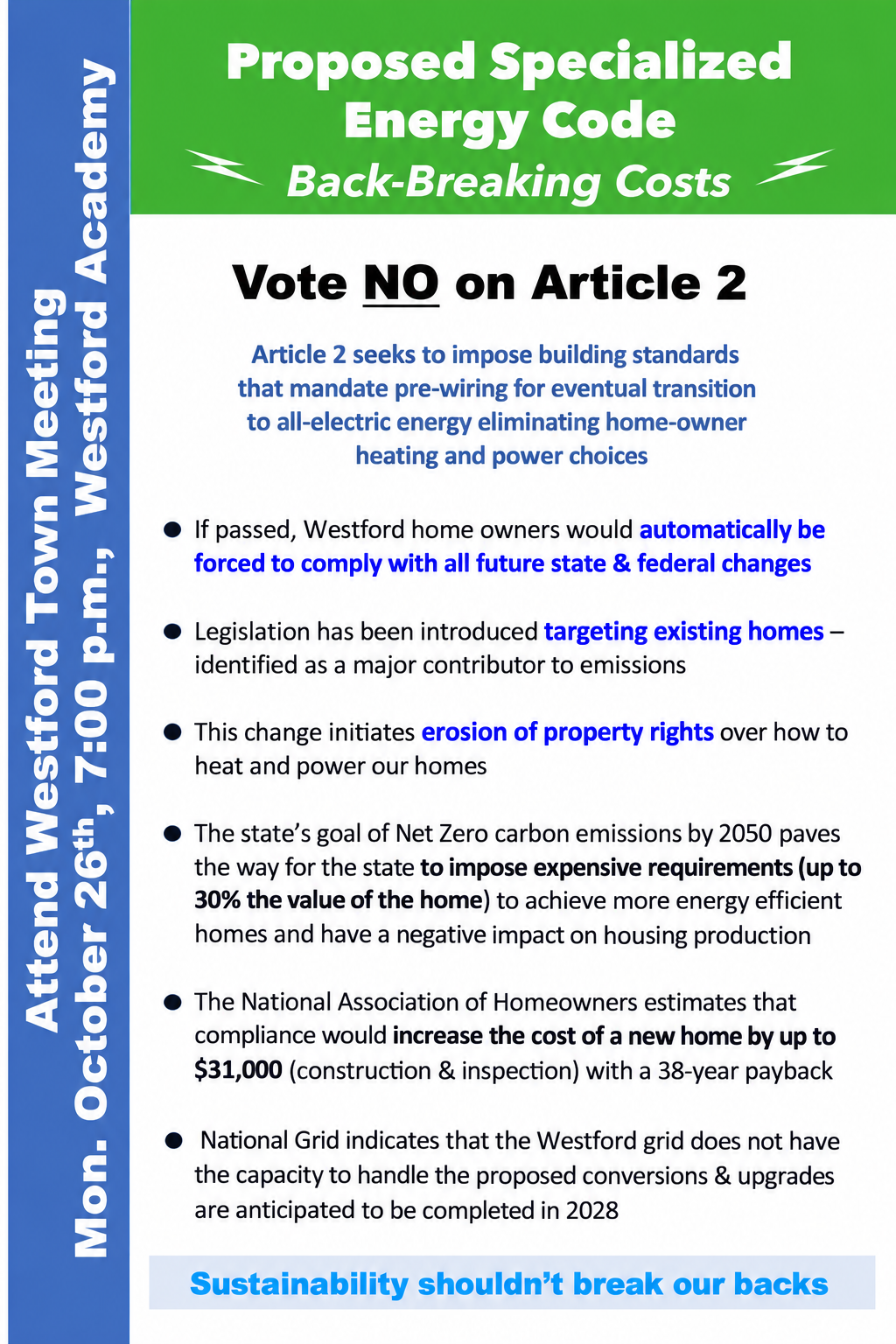
Special Town Meeting, Monday, October 26, 7:00 p.m., Westford Academy
Westford voters already rejected this. At Annual Town Meeting in 2025, Article 20 failed 165–137. Article 2 is the same opt-in code, brought back so the town can qualify for state Climate Leader grants. A grant application is not a reason to rewrite the rules for every new home in town.
Westford already uses the Stretch Energy Code. That is the efficiency standard required for Green Communities, which we joined in 2013. Article 2 piles a second code on top, written to match the state’s net-zero-by-2050 mandate.
Here is what the town’s own page says it does to new construction:
- A new home that keeps gas, oil, or propane for heat, hot water, cooking, or drying must be pre-wired for later electric conversion.
- That same home must install rooftop solar — at least 4 kW per unit — unless the roof is too small or too shaded, or the builder meets the Passive House standard instead.
- A new home of 4,000 square feet or more that is not all-electric must offset all of its energy use with on-site renewables.
- New multifamily buildings over 12,000 square feet must meet Passive House.
All-electric new buildings mostly escape the extra rules. Mixed-fuel buildings do not. Gas is not banned on paper. It is priced and wired out of reach. The state’s own explanation of the pre-wiring rule is blunt: future retrofits “will be necessary to meet the Commonwealth’s climate goals.” Article 2 is the on-ramp, not a voluntary efficiency upgrade.
That is a real cost. Home-builder estimates put specialized-code compliance near $31,000 on a new home, with a payback measured in decades. A mandated 4 kW solar array alone runs on the order of $11,000 before incentives in this market. Those costs land on the price of a new house, which already shuts out young families. People who want heat pumps and solar can install them today. They do not need Town Meeting to make the choice for the next buyer.
Last time, the Economic Development Committee, the Zoning Board of Appeals, and the Permanent Town Building Committee all recommended against it. National Grid has not shown that Westford’s grid can absorb a wave of new all-electric houses on the timeline this code assumes. Efficiency that depends on a grid upgrade the utility has not finished is not a plan. It is a bet with someone else’s mortgage.
Article 2 does not apply to renovations of the house you already own. Do not let that reassure you. The code is built around the assumption that fossil-fuel heat in new houses is temporary, and that the state will close the gap later. Voting yes hands Boston a local hook for every future change to that appendix.
Sustainability that residents choose is fine. Sustainability that Town Meeting imposes, so the town can qualify for a grant, is not. We already said no.
Leave a Reply