
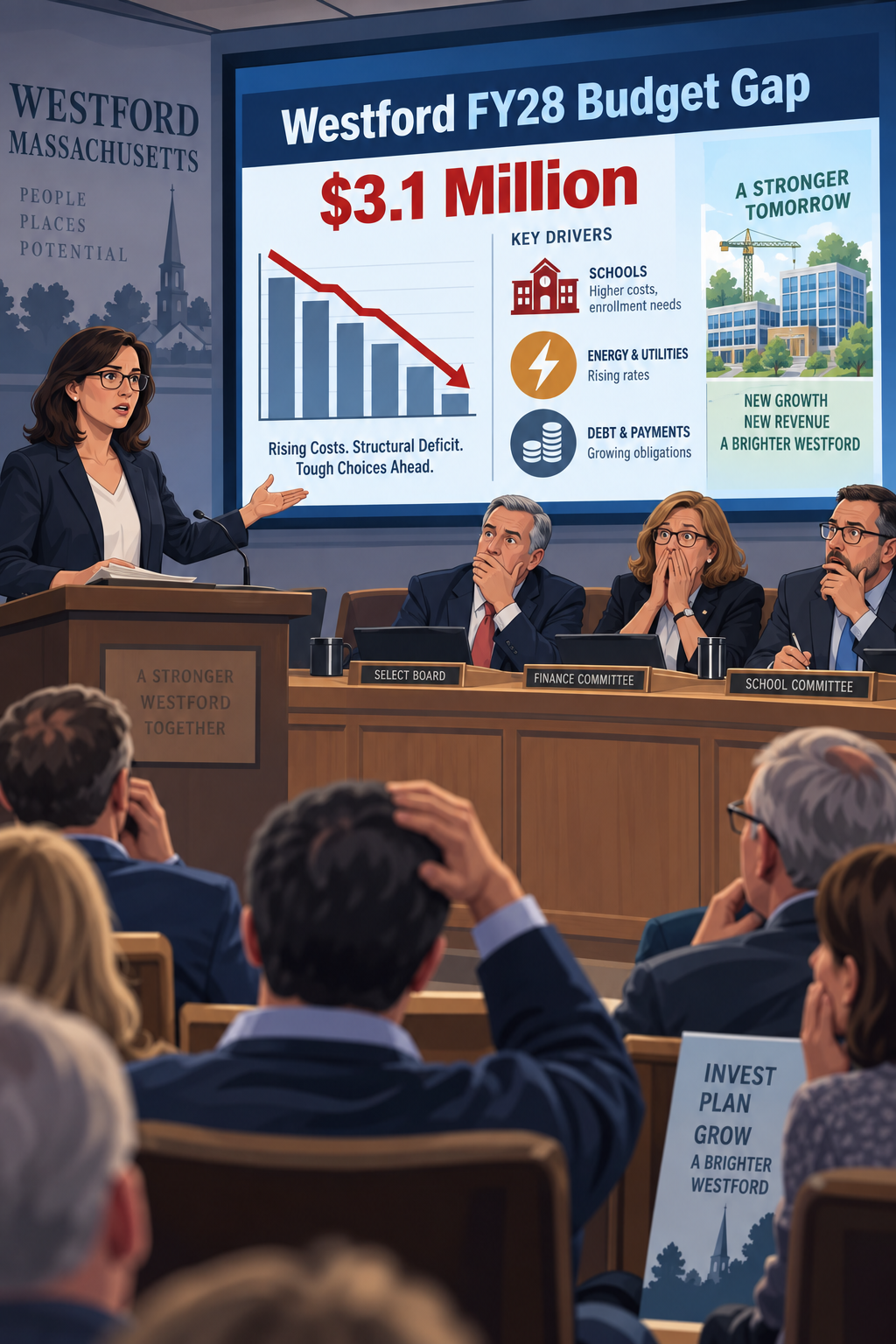
Structural Deficit Causes Largest Budget Gap In Recent History
Jaws dropped at last week’s Tri-board’s meeting, when Town Finance Director Dan O’Donnell reported, that the town is staring at a 3.1M hole in its’ FY28 budget. The ”Triboards Meeting” refers to a periodic joint meeting of the Select Board, Finance Committee and School Committee to address town fiscal concerns. Town Manager Kris Las, attributed the gap to the “structural deficit” that she has labored under during her entire tenure as town manager. Las recently resigned and will be leaving town service at the end of the month. A structural deficit refers to a situation where costs rise faster than revenues, because of legal limits on the amount of money a community is allowed to raise in property taxes in one fiscal year. A host of cost saving measures instituted by Las over the past three years have not slowed the rate of this growth, the gap has only grown worse.
Factors contributing to the gap include the use of one time funds spent in the FY27 budget, which are longer available for FY 28. School transportation and Special Education costs that continue to rise; as well as, energy and utility costs, that are also rising. Payments to the Middlesex retirement account and other employee benefit funding, along with deferred town building maintenance and a continuing commitment toward offering competitive salaries to employees, round out the funding commitments that have sucked town revenue dry. O’Donnell broke down the cost increases for both the town side and the school budget. On the town side (police, fire, DPW etc) the budget has increased from 29M last year to 31M this year, a 5.81% increase. The school side of the budget has increased from 71.5M to 75M, a 5.4% increase. Payments to the Nashoba Valley Tech are also expected to rise by 5.0%.
Debt payments will also increase. Payments on the JV Fletcher library will increase by 758K. Additional projects, to include repairs to the DPW Beacon Street garage, Rte 110 Road widening, and repairs to the HVAC system at the Cameron Senior Center will add another 337K to excluded debt. Westford property tax-payers will see these additional charges on their property tax bills. These increases are exempt from the restrictions imposed by proposition 2 ½ because excluded debt payments only extend for the length of the loan repayment and do not represent a permanent increase in the tax rate.
The fiscal news sparked comments. Finance Committee member Dennis Galvin said that a “structural problem” requires a “structural solution.” He pointed to state policies as contributing to the deficit: such as insufficient local aid; commercial property tax loss, a consequence of the state’s sales tax; increased energy and health insurance costs, resulting from state policies. Select Board member Tom Clay somberly interjected that the cost spike was “driven by the contracts” referencing recent multi-year contract settlements with Westford town employees. Galvin followed up on Clay’s comments stating that the teacher’s union received a 10% contract boost over three years. He asked Dr Chu if he was intending to pass that same increase on to the non-union administrators in the school system. Chu said that he had not made up his mind as of this time.
Finance Committee member Nate McKinnon expressed his deep disappointment over a vote taken by the Health Insurance Trust which essentially rejected the possibility of transitioning town employees and retirees to the state’s GIC health insurance program, a plan that claims to offer significant savings. McKinnon said that with the town facing a 3.1M deficit, “ it is imperative that the move to GIC be considered.”
Finance Director Dan O’Donnell did his best to quell the anguish that was evident in the room, following the news of the deficit. He assured everyone that an effort will be made to close the gap before post time for the 2028 budget in December. He pointed to 950K in savings realized by the Health Insurance Trust which will be returned to the general fund. He expressed his intent to level fund OPEB and he pointed to an anticipated 2M to 3M in new growth revenue related to several developments scheduled to break ground this fall.
Development
DEVELOPMENTS RAISE HOPES FOR FINANCIAL RELIEF
Is New Growth Sufficient To Plug Budget Gaps ?
Town Leaders are hoping for action on three new developments proposed for Westford this fiscal year, as a means of bailing the town out of a tight financial bind. These projects offer the prospects for added revenue, which could help fill a 3.1M budget hole. Under Massachusetts Law, new construction in any community, during any given fiscal year, can be assessed for tax revenue and that assessment can be fully applied to the town tax levy.
There are three pending projects, that will be subject to new growth assessments. However, the issue for FY 2028 is whether these projects will develop fast enough and be assessed, in time to help the FY2028 budget. The Guitierrez company is proposing an 80 unit condominium development in Tech Park East. The start date for this project will be November of this year, If this moves forward as scheduled it will be subject to new growth assessment. Redgate, is the second project and it involves the redevelopment of the former Westford Regency property. It is also scheduled to begin in November, though the start date has been moved back at least once. This project involves the development of two apartment buildings containing 150 units each. The last project is 37 Powers Road, which is a massive 530 unit apartment complex located off of Powers Road. No starting date has been announced for this project.
The town will be able to recoup additional new growth revenue from these projects each year during their construction until the projects are completed. Development of land increases its value. Two of these projects are projected to take two years for full build out, which means that the town could collect increased levels of revenue each year up until the projects are completed. Continuing construction increases the land value. Town budget planners are anticipating 1M in new growth revenue this year from these projects pending certification of the assessments by the Massachusetts Department of Revenue.
Leave a Reply