
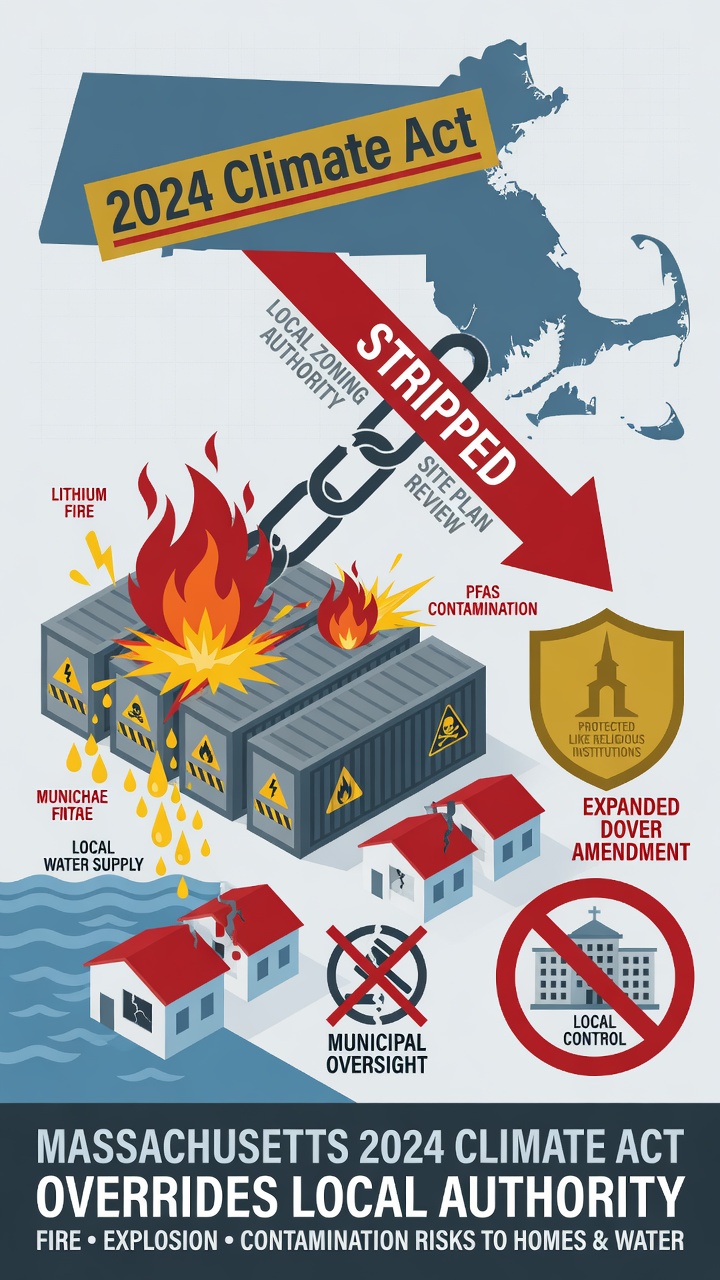
Draconian ’24 Climate Act Strips Town of Zoning Control: Site Plan Review Is Restricted
The Massachusetts State legislature has KO’d Home Rule in this Commonwealth once again, with a powerful combination of statutory changes that eliminate zoning authority and restricts site plan review over some very controversial uses. This is all part of a “one- two punch” strategy to wrest zoning authority away from the municipalities and transfer it to the state. The MBTA zoning act forced towns to zone areas to accommodate multi- use residential construction. That act was the jab intended to put municipalities off balance; the knock-out blow was the 2024 Climate act, which is now being implemented throughout the Commonwealth. It literally strips towns of their zoning and site plan review authority over a land use that requires particularly close oversight.
Policies that strip local communities of their zoning and site plan review authority place all homeowners at financial and environmental risk. Such action can result in the siting of a noxious, dangerous or unsightly use near residences, which can devalue the property of surrounding homes and expose residents to health hazards. In this case the state has removed local zoning and site-plan authority over a particularly hazardous use, battery energy storage systems (BESS). These facilities pose a risk of thermal runaway- a continuous and unstoppable self- sustaining chain reaction fire hazard; explosion, caused by improperly controlled battery emissions and in the case of fire, ground and water contamination caused by the runoff from fire suppression operations. This runoff can carry contaminants into the soil and the water supply.
The Westford Planning Board heard a presentation from Jeanne Raitte and Kerry Lynema, from the Northern Middlesex Council of Governments (NMCOG), last Monday who laid down the new realities for zoning and site plan review in Massachusetts. The 2024 Climate Act has made solar facilities and battery energy storage systems (BESS) sacred cows in this Commonwealth. The town cannot apply zoning to them and the authority to review and impose restrictions has been significantly limited.
Local Zoning authority was cynically curtailed by the state legislature who outrageously decided to extend Dover Amendment protections to these facilities. The Dover Amendment is a long-standing statutory protection reserved for religious institutions to protect them from discrimination, when applying for permits to construct churches, synagogues, temples or mosques. The legislature has now extended this same protection to these two new sacred institutions, which are vital for supporting the state’s climate change agenda. However, unlike religious institutions, which are spiritually oriented and offer no material threat to the environment, battery storage facilities pose a significant threat to the communities they are located in. IZON has learned that the town of Westford is not even permitted to restrict these facilities from water aquifer protection areas.
The Climate Act also attempts to create the illusion of municipal control by instituting a local review process. However, applicants are only required to submit information, that is requested on a pre-established state form. The town can reject the application for failure to complete the form, or for filing false or inaccurate information, but it cannot conduct an independent review of a siting plan. Requiring an applicant to foot the bill for site plan peer review, which has been standard practice for both the Planning Board and Zoning Board of Appeals is now banned for these facilities. If the town wants clarification about an identified concern, it must utilize only state consultants.
The Climate Act extends limited municipal review authority to what are termed “Small Clean Energy Facilities” (SCEF). These are facilities that produce between 25MGW and 100MGW capacity. The NMCOG representatives presented photographs of facilities that fall within this capacity. The area scale of these facilities fall between 0.4 acres and 200 acres. The town has no control to regulate the siting of BESS facilities larger than the 100MGW top limit. Those applications are approved by the sole authority of the Energy Facility Siting Board (EFSB) a new state mega-authority, that issues permits for all large scale facilities and hears appeals by applicants rejected by municipalities.
The 2024 Climate Act, which is the enabling legislation for the changes described above was passed on November 14, 2024 by the Massachusetts House of Representatives on a 128-17 vote along straight party lines. All Democrat state representatives voted for this bill. All 17 Republicans in the House opposed it.
Leave a Reply