
Town Meeting Editorial: Threat of Dumping, Increased Cost and State Mandate Outweighs Benefits
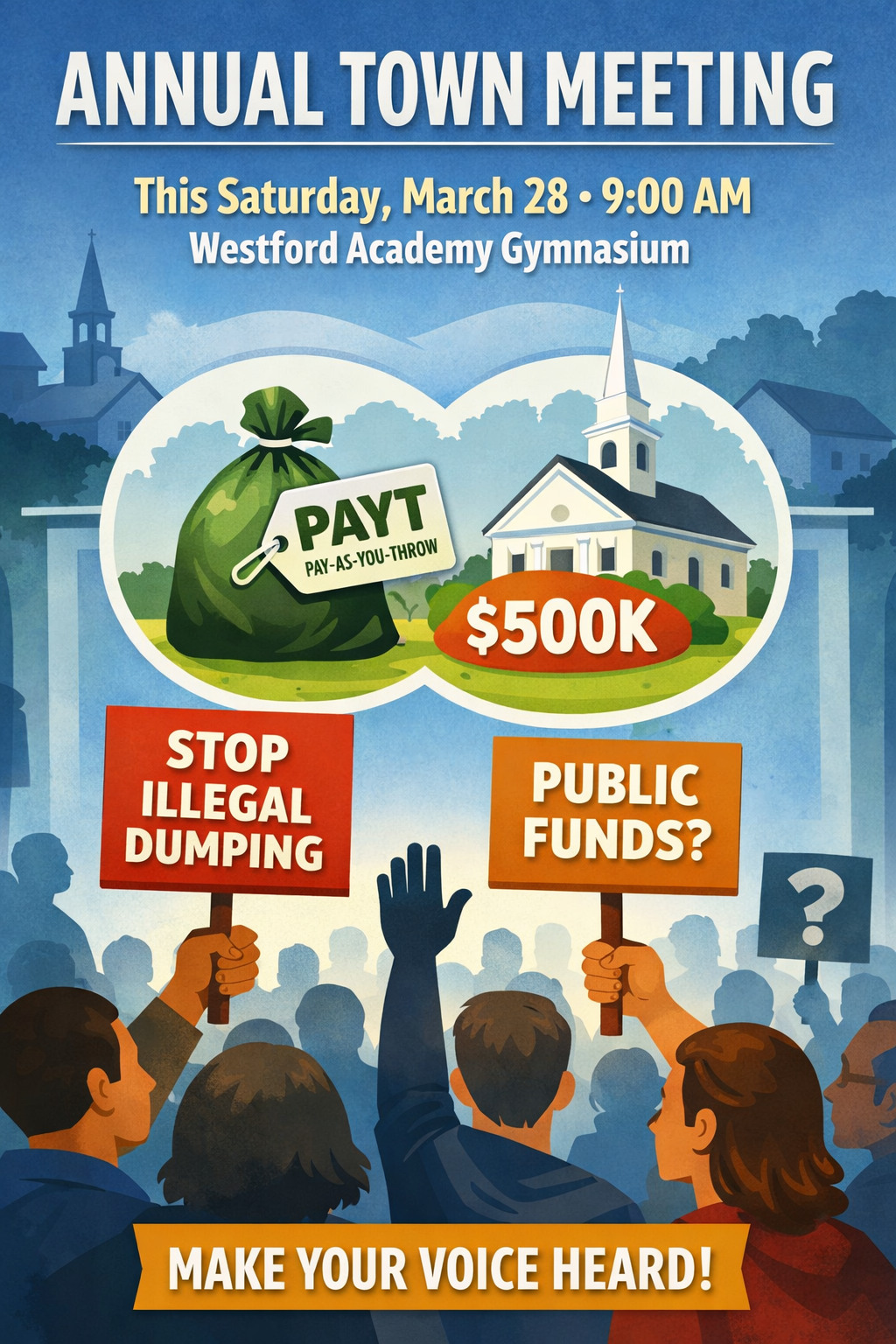
This Saturday is town meeting. It will begin at 9A at the Westford Academy gymnasium. It is important that you attend this meeting. Most of the warrant is pretty pro-forma. There are no overrides, nor are there any debt exclusions. There are only two articles that are of concern. The first concern are articles associated with Pay As You Throw (PAYT), a program that has been strongly pushed by the town administration (Articles 2, Article 13). The second issue is an exorbitant appropriation for the First Parish Church. Let’s dive into these:
On the matter of PAYT, the action will begin very early. Under Article 2 in the town warrant there will be four separate motions to authorize various appropriations. The first motion under that article seeks to appropriate 150K from free cash to provide the initial seed money for the PAYT program. The town administration plans to support this appropriation by applying for a 246K grant from the state’s Department of Environmental Protection. (DEP). This motion will be challenged and there will be an amendment to delete the 150K for waste disposal. You should support this amendment and here is why:
First, the PAYT program will impose direct costs on residents whose weekly trash exceeds a 35 gallon limit. This limit is unrealistic. A two person household can probably comply with that limit, but anyone with more than two people, let’s say two or three kids, will most likely exceed it. This will force them to pay an additional $2.75 a week to purchase one bag to supplement their trash collection. If they need more bags, they must dish out another $2.75 for each bag they need. A household that requires just one supplemental bag per week will end up paying an additional yearly fee of about $145.00. Parents with children will find themselves penalized as a result of this program.
Second, because the PAYT program imposes restrictions on the amount of trash that one household can dispose of, it runs the risk of provoking unlawful dumping. The convenience of putting your trash out for collection will now become very complicated and expensive. Unfortunately, it is not unreasonable to expect, that some individuals may begin dumping their excess trash in open landfills or in industrial dumpsters all over town,
Lastly, the limitations on trash tonnage, which is what is driving the cost, have been contrived by environmental interests on Beacon Hill. There is a movement that seeks to totally eliminate land fills in this commonwealth. Just this year the state closed two of them leaving only five to serve the Commonwealth. These closures increased the cost of trash tonnage for each town and are part of a state-wide effort to make Massachusetts a “ trash free” state by 2030. The limitations that are now being imposed will be followed by even more restrictions in the years to come.
Beacon Hill has adopted a radical environmental agenda, which has resulted in skyrocketing energy costs across the state. The Governor and Legislature are now locked in a struggle to tamp down some of the extreme climate mandates, that were set a few years ago, because residents simply cannot afford them. “Trash Free 2030” is a part of this agenda. It reflects the unrealistic and radical orientation of environmentalists in this Commonwealth, who would foist the cost of saving the planet onto state residents, while placing little emphasis on developing new technologies to achieve the climate goals they seek. Send the message that you want common sense to rule climate policy not fanaticism at your expense.
ARE WE HELPING OR SUPPORTING THE FIRST PARISH CHURCH
How Much Should One Private Entity Receive From CPA Funds ?
Article 10 on the warrant will involve an approval of disbursements from the town’s Community Preservation Fund. This fund was originally set up close to two decades ago with the intent of assisting towns with the purchase of open space to limit over development. During that time, eligibility for receiving funding expanded to include recreational and historical interests. These interests can apply to the Westford Community Preservation Committee and if their applications are approved, they can receive money from a town account that was set up through the Community Preservation Act. These funds are automatically cutout of the town’s annual property tax levy. Westford contributes about 3% of its tax levy to this fund. The Community Preservation Committee administers the fund and makes the disbursements.
Article 10 seeks to authorize a disbursement of about $500K to the First Parish Church. The church qualifies under the CPA law as a historical site and there is no argument about that. The concern lies in the amount of money that is being proposed. $500K is a significant amount of money. The original request was for 1M. The First Parish Church previously received a 1M grant from the Community Preservation Act a few years ago to repair an elevator. The money is sought this time to repair a steeple. During discussions with the Finance Committee, Bob Jeffries the new chair of the Community Preservation Committee, advised that 200K has already been raised by the parish and that several grants have been applied for. The First Parish Church is a private religious institution. This begs the question, how much of a commitment should town taxpayers make to a project, that while arguably preserving a historical landmark, will also relieve financial pressure from an active church congregation. Westford should support its historical landmarks, but particularly in matters involving religion it must be more circumspect. Some contribution would seem to be proper in this case, but the amount that has been recommended goes beyond help and crosses the line into support. That is something that the town should steer clear of.
Leave a Reply