
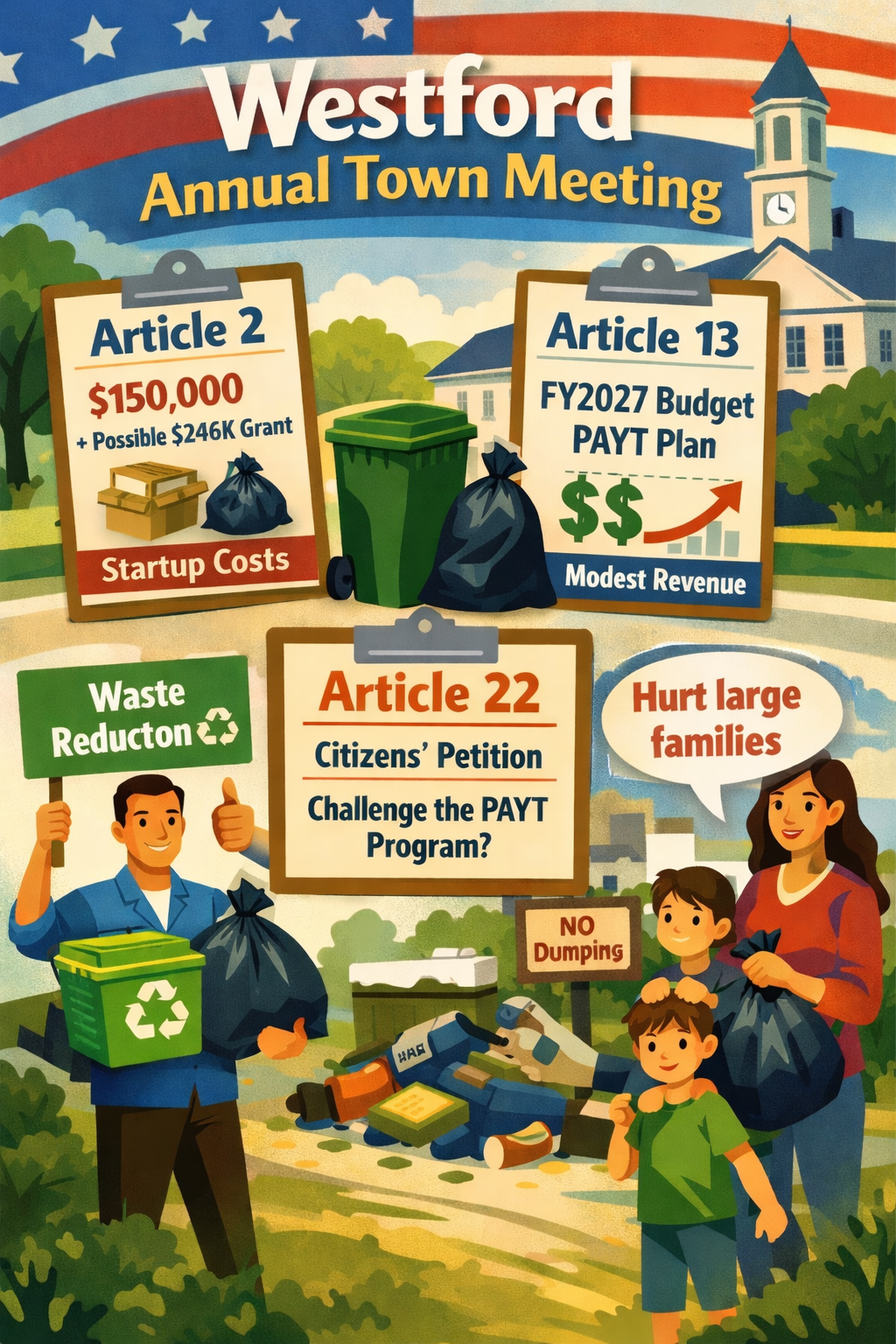
There are several articles in this years town meeting warrant that should be understood.
Primary among these are the articles related to the Pay-To-Throw (PAYT) program passed by the Select Board. These articles are at the top of the agenda, so will be debated at the beginning of the meeting. There are two articles in the warrant that are required to implement this program. The first is Article 2. This article funds the start-up costs for the program i.e. purchase of the 35 gal trash containers and an initial supply of overflow bags to be distributed around town.
The second is Article 13 which funds the entire 2027 Waste Collection and Disposal budget including the full adoption of the PAYT program.
Finally, Article 22 is a non-binding citizens petition to determine the level of support for the PAYT program. Since it is non-binding it is for information only.
Details
Article 2 : This article will appropriate $990,000 in free cash to supplement FY26 budgets and fund four programs
Included in these appropriations is $150,000 for funding the Pay-As-You-Throw (PAYT) program scheduled to take effect July 1, 2026. Along with the $150,000 from this appropriation, the Town intends to apply for a MassDEP Pay-As-You-Throw Implementation Grant in the approximate amount of $246,000 for PAYT startup costs including 35-gallon carts for residents and the purchase the initial supply of PAYT overflow bags. If Article 2 passes, the Town will be investing approximately $400,000 in startup costs to adopt PAYT. The FY2027 budget impact includes $275,000 in projected revenue from bag sales, offsetting $220,825 in total program costs, resulting in a net revenue of only $54,175.
Pros:
- This article provides funding to start the PAYT program including purchase of the 35 gal containers and an initial supply of overflow bags
- These start-up funds will allow the full program to be initiated.
Article 13: Approve Fiscal Year 2027 Operating Budget
This article includes the 2027 Waste Collection and Disposal budget (dept 430). Westford budgeted $2,612,442 in 2026 and $2,833,267 in 2027 an increase of 8.45% with the adoption of PAYT.
The 2027 budget includes
- The hiring of a ‘Management Analyst’ at $80,000 to support town activities
- $40,000 in collection fees for overflow bagsOver $90K in expenses for 35 gal trash containers and bags$30K for additional recycling programsWestford has had declines in tonnage for solid waste and recycling over the last decade. 2025 had the lowest solid waste in a decade with over a 14% decrease from 2024 to 2025 with the new vendor
- The FY2027 budget impact includes $275,000 in projected revenue from bag sales, offsetting $220,825 in total program costs, resulting in a net revenue of only $54,175.
Pros:
- The town wants to reduce waste and limit the variable components to its waste collection
- The program and budget anticipates a 11% reduction in trash tonnage (on top of the 14% accomplished in 2025) saving approximately $85,000 in disposal fees
- The budget includes funds to expand and supplement our current recycling programs.
Cons:
- Discriminates against large families who have larger amounts of trash
- The town is raising expenses almost $221,000 for a net positive budget of $54,000.
- The PAYT program aligns with a state effort to achieve “Trashless Mass by 2030” – an unfunded goal.
- PAYT and reduced tonnage may lead to more dumping of trash along roads and illegal use of private dumpsters
- The Town is investing in administrative staff while there are current needs for teachers and first responders. The new position will cost more than $80,000 when benefits are included
- Existing barrels will be obsolete generating unnecessary waste
- Much analysis with in the town may be done with AI improving efficiency and accuracy
- The anticipated double digit reduction in tonnage after a 14% reduction in 2025 may be difficult to achieve and there is a limit to what further reductions can be achieved in the future.
Other articles explained
ARTICLE 8: Adopt the Prudent Investor Rule
Adopt the Prudent Investor Rule This article will allow the town to invest in higher growth assets rather than the conservative ones they invest in today.
Pros:
Investing in higher growth assets may generate larger income for the town
Cons:
The financial advisor is not identified to know his track record and costs. Investing is inherently risky and the town may not be able to absorb losses.
A typical advisor has a fee of 0.5% to 2% of assets under management annually which will be taken from proceeds (assuming the increase in proceeds over existing investments exceeds this number)
Article 10 Approve Community Preservation Committee
Includes funding ($500K) for the steeple repair at First Parish Church under the historical provision of the CPA
Pros:
The steeple is part of the historical church
Cons:
- The church is not town owned
- The church is partisan in the activities it engages in and supports
Article 20: Authorize Digital-Only Legal Notices
AN ACT ALLOWING “PRINT-FREE” DIGITAL LEGAL NOTICES FOR THE TOWN OF WESTFORD
Requires State legislature approval
Article 21 Adopt General Bylaw Prohibiting Virtual Currency Kiosks
Amend the Town’s General Bylaws to add a new provision prohibiting the installation Select Board and use of virtual currency kiosks, also known as Bitcoin ATMs, Cryptocurrency Machines.
Article 22 : This is a non-binding citizens petition to repeal the SB’s decision to implement the PAYT program
The Select Board made the decision to implement the PAYT program rather than let voters decide and Town Meeting. While this is legal, this article will challenge that decision
Pros: It will demonstrate to the SB the level of support for the PAYT program
Cons: This is a non-binding vote, so it can be ignored
Leave a Reply